
Liriodendron tulipifera (Tulip Tree / North American Tulip Tree) is native to the eastern regions of North America. It naturally grows in mixed forests, especially in moist valleys and damp slopes where the soil is well-drained. It is a tall and impressive tree that typically reaches 25–35 meters in height, with a wide crown spreading about 15–20 meters. The tree develops a straight trunk and a pyramidal crown, giving it a strong and elegant appearance.
🍃 As the tree matures, its main branches often appear slightly twisted, while the lower branches hang downward and the side branches extend irregularly, creating a picturesque form. The summer leaves are deciduous, arranged alternately, and are highly distinctive. They are shaped somewhat like a saddle or a square form with a central lobe and two large side lobes. The upper surface of the leaves is bright green, and in autumn they turn a striking golden yellow color.
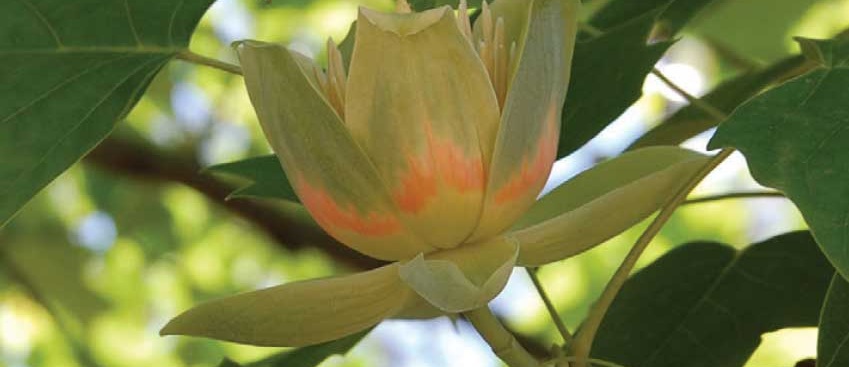
🌸 The flowers resemble tulips in both shape and size, which is the origin of the tree’s common name. Their main color ranges from sulfur yellow to yellow-green. Orange-colored pollen sacs are located inside the flower, beneath the petals. Flowering occurs from late May to late June, providing a beautiful seasonal display.
🌰 The fruit is a cone-like structure that stands upright and is about 6–7 cm long. The tree has a shallow root system made up of many horizontal fine roots. Because of this structure, it prefers wide growing spaces to develop properly.
☀️ Tulip trees grow best in sunny locations. They prefer deep, moist, nutrient-rich, well-drained soils that are either acidic or neutral. Although they can survive in drier conditions, their growth is significantly reduced in such environments.
🌿 In landscaping, Liriodendron tulipifera is widely used in parks, especially in Central Europe. For example, a tulip tree planted in 1914 in the Reutlingen Arboretum in Germany reached a height of 30 meters by 1980, showing its long lifespan and strong growth potential.